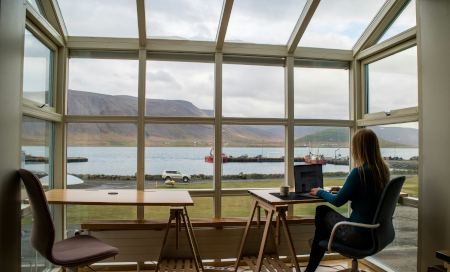
Remote Working in Iceland Self-Portrait,
by Kristin Wilson,
Unsplash Free license
By Luke Murray
For hybrid employees, full-time remote staff, and freelancers running a home office, the remote work environmental impact can feel oddly hard to pin down. Telecommuting can shrink an individual carbon footprint by cutting commutes, yet home energy consumption often rises and everyday routines shift in ways that are easy to overlook. That tension matters because telecommuting and climate change are connected through thousands of small, repeated choices that add up over time. A clear view of what changed helps remote workers build sustainable work habits with confidence.
Telecommuting changes your footprint by shifting energy and travel from the office to your home and your screen time. Carbon reduction happens when avoiding driving and office building demand outweigh added heating, cooling, lighting, devices, and internet use. That balance is why remote workers’ carbon footprint can drop sharply for some people, but not automatically for everyone.
This matters because “working from home” is really a bundle of habits you can redesign. When you know which activities raise electricity and which reduce emissions, you can focus on the few routines that move the needle. The result is a greener workday without constant sacrifice.
Picture a typical Tuesday: you skip a 30-minute drive, but you run the AC all day and keep multiple monitors on. Add video calls and cloud tools, and data centres become part of your indirect energy use. With the tradeoffs clear, online upskilling can fit your schedule while cutting extra travel.
Once you’ve weighed remote work’s environmental tradeoffs, the next question is how to keep building your career in ways that don’t add travel back into the equation. Earning an online degree can sharpen the very skills that make remote work successful, like collaborating and learning in digital-first environments, while also cutting emissions you’d otherwise generate commuting to classes. Because you’re not traveling to and from campus as often (or at all), and because less in-person attendance can mean less on-site energy demand, virtual education can be both a practical career move and a more environmentally sustainable choice. With a cybersecurity degree, you can learn about protecting a business’s computers and network systems. If you want a starting point, a quick orientation can help you explore a career-focused program.
A greener work-from-home setup doesn’t require a remodel, just a few fast choices you can repeat every day. Use this 10-minute checklist to cut waste and energy while keeping your workspace comfortable and productive (especially helpful when you’re balancing work with an online course schedule).
Do a 60-second “power scan” and kill idle load: Unplug chargers you’re not actively using and connect your desk gear to a power strip so you can switch everything off in one move. Set your computer and monitor to sleep after 5–10 minutes and turn off “wake on” features you don’t need. This targets the sneaky electricity draw that adds up when you work from home most days.
Optimize your desk for daylight before you touch a thermostat: Move your workstation closer to a window, then open blinds and angle your screen to reduce glare. If you need task lighting, use an LED desk lamp and point it at your work, not the whole room. You’ll often avoid turning on overhead lights for hours, which is one of the easiest ways to start reducing home electricity consumption immediately.
Create a “heat/cool bubble” instead of conditioning the whole home: Close doors to unused rooms, add a draft stopper if you feel airflow, and keep a throw blanket or light layer at your chair. If you use heating or AC, aim for small adjustments (think 1–2 degrees at a time) and stick to a consistent schedule so the system doesn’t constantly ramp up. Since 31% of U.S. households report challenges paying energy bills or maintaining adequate heating/cooling, efficiency habits can support both sustainability and your monthly budget.
Right-size your tech for remote learning and work: If you’re using an online degree program to build remote-ready skills, keep your setup simple: one primary device, one external monitor only if it truly boosts focus, and audio gear that doesn’t require constant charging. Lower screen brightness to the lowest comfortable level and turn off nonessential Bluetooth connections. This reduces energy use while keeping your study-and-work routine reliable.
Switch to eco-friendly office supplies with a “replace-as-you-run-out” rule: Don’t toss what you have, start a running list and swap in better options as items finish. Choose refillable pens, recycled-content notebooks, and minimal packaging; store a small box for paper you can reuse for scratch notes. When you print, default to double-sided and keep a single “print only when required” folder for school forms or legal documents.
Lock in two tiny behavioral changes that make the setup stick: Add a calendar reminder for a 2-minute end-of-day shutdown: power strip off, lights off, laptop closed. Then add a weekly 5-minute reset: clear clutter (less “lost item” re-buying), consolidate charging to one session, and restock reusable supplies. If you want a ready-made checklist format, Sheridan College’s Green Office At-Home Resources offer a simple template you can adapt.
Q: How does working from home actually lower emissions?
A: The biggest win is usually skipping the commute, which cuts fuel use and traffic pollution. Many office workers lose hours every month in cars, and removing even a few trips a week can add up fast. To lock in the benefit, bundle errands and choose one low-travel day for appointments.
Q: What if my home heating or AC cancels out the commute savings?
A: It can, especially if you condition a whole home for one person. Focus on comfort where you are: close off unused spaces, dress in light layers, and make small thermostat changes instead of big swings. If you share a home, agree on a schedule so the system is not constantly chasing different preferences.
Q: How can I stop “always-on” devices from wasting energy?
A: Start with one rule: if it does not need to run overnight, it powers down. Use a switchable power strip for desk gear, enable sleep settings, and batch charging into a single daily window.
Q: Should I keep my laptop on all day for messages and meetings?
A: Not usually. Set clear availability blocks and let your computer sleep between them so you are not burning power during quiet periods. If you need fast responses, use a low-power notification method like phone alerts during your work window.
Q: Can remote work still help if I only do it one or two days a week?
A: Yes, because consistency matters more than perfection. With 22% of the workforce working remotely, even part-time telecommuting can reduce repeated travel and daily building demand. Pick fixed remote days so your household can plan meals, laundry, and heating or cooling around them.
Remote work can lower emissions, but the day-to-day tradeoffs, heating and cooling, always-on devices, and scattered routines, can quietly cancel out the gains. The way forward is a simple mindset: treat sustainable remote work habits as small systems that fit real life, not perfect rules. When personal environmental responsibility becomes routine, it turns into long-term eco-friendly behaviors that shrink home energy use and strengthen remote work and climate action over time. Consistency, not perfection, is what makes remote work greener. Pick one change to try this week and keep it steady long enough to become automatic, because inspiring green lifestyle changes add up to a more resilient, healthier home.

We are all very passionate about the climate emergency and the dramatic loss of biological diversity on Earth . . . Learn about us



Copyright ©
Climate Emergency Forum